
Where to Buy Macleaya Cordata Extract from a Reliable Supplier
Nov 17, 2026
If you are acquiring macleaya cordata extract for a supplement, feed, or cosmetic composition, you need more than a competitive quotation. You require verification of plant identification, validated alkaloid content, and batch-level documentation. This guide will assist you to distinguish a reliable supplier from a harmful one — from sanguinarine requirements to HPLC results and export paperwork. I’ve reviewed hundreds of procurement discussions with buyers from throughout North America, Europe, and Southeast Asia to prepare this, so every checklist item is based on actual sourcing choices, not conjecture.
Before going into the whole explanation, the short answer: acquire Macleaya cordata extract from a company that can confirm plant identification, offer a batch-specific certificate of analysis, and tell you precisely how sanguinarine and total alkaloid levels are evaluated. Everything following addresses the next questions that procurement teams, QA managers, and formulators ask. Contact us at info@kingherbs.com.
When comparing providers, a few criteria are more important than pricing. Before you can even talk about assays, you have to ensure botanical identification, since if you have the incorrect plant part or a substituted species, you will never get the alkaloid profile you want. Commercial extracts may vary from 0.15% sanguinarine to 80% sanguinarine. A 10% grade and an 80% grade are not interchangeable goods but are separate formulations altogether. The choice of extraction solvent also impacts the results; e.g., water extraction and ethanol extraction might provide distinct impurity profiles even from the same batch of raw plant. And finally, a certificate of analysis that only states “pass” with no figures is not a true quality document; it’s marketing paper.
What Is Macleaya Cordata Extract and What Are Its Main Applications?
Macleaya cordata extract comes from a flowering plant in the poppy family, and understanding the source plant helps explain why quality varies so widely between suppliers.
Macleaya Cordata (Chinese Name) and Botanical Identity
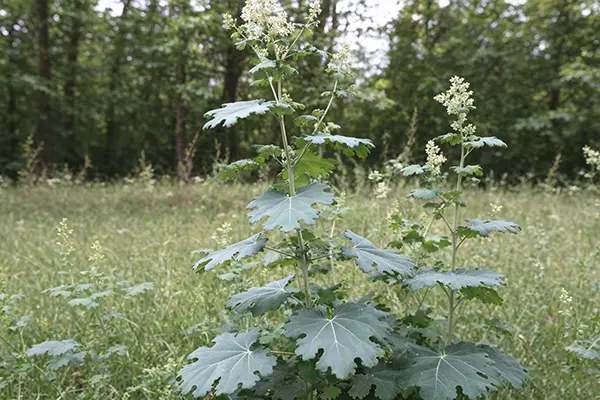
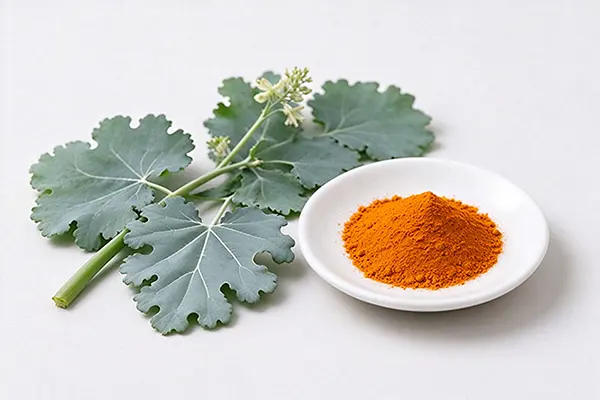
Its scientific name is Macleaya cordata (Willd.) R. Br. The English popular name is plume poppy. You may find it referred to by its Pinyin name, bo luo hui, in Chinese source papers. It is a member of the Papaveraceae family, like the opium poppy, but has different chemistry and regulation. The botanical raw material is the dried pod, leaf, or complete plant before processing, while the final extract is the standardized powder obtained following extraction, concentration, and drying. When asked, a good source should be able to provide the Latin name, portion of the plant used, and where it was grown.
Morphological Features, Distribution, and Growing Environment
Plume poppy is a tall perennial plant, frequently exceeding six feet in height, with lobed grayish-green leaves and little cream colored flowers. Yellow-orange latex flows from severed stems, a clear sign of alkaloid-bearing tissue. It is grown and wild-harvested in regions of East Asia, particularly China, where the majority of commercial extraction takes place. The ultimate concentration of alkaloids in the raw material depends on the nature of the soil, rainfall, time of harvest, and the rate of drying. Good origin does not guarantee a high-grade extract; it’s the processing and testing that determine the final product.
Main Applications and Scope of Use
Studies have been done on this macleaya cordata extract’s antibacterial and antioxidant activities, mostly due to its benzophenanthridine alkaloids, but without backing any authorized health claims. The commercial usage is now concentrated in 4 locations. It is used in animal nutrition and livestock research in antibiotic-free feeding regimens. Poultry and aquaculture farmers see it as a gut health element. It's used in multi-ingredient mixes by botanical formulators. Laboratory researchers utilize analytical lots in analytical work. Each of food, feed, cosmetic, and pharmaceutical uses requires a separate regulatory examination in the market of destination before being commercially launched. Contact us at info@kingherbs.com.
Which Active Ingredients Should Buyers Look for in Macleaya Cordata Extract?
Knowing which compounds to specify protects you from buying an extract that looks right on paper but performs inconsistently in your application.
Major Macleaya Cordata Alkaloids
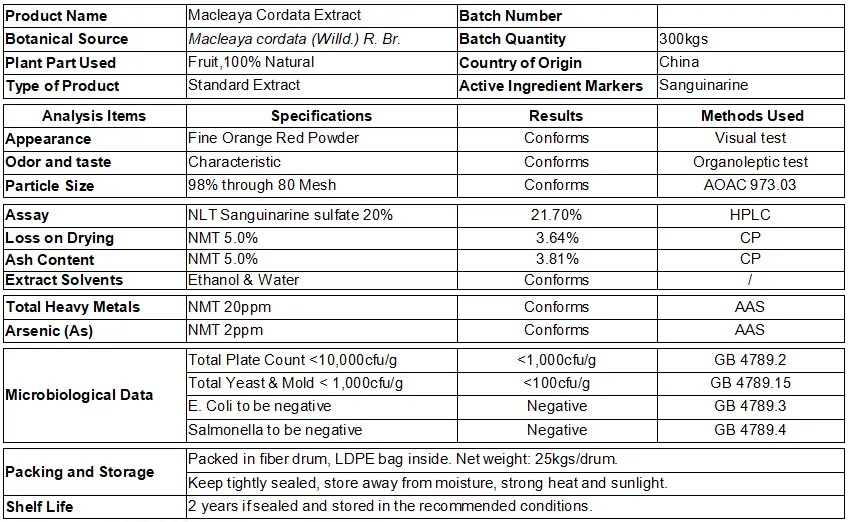
The four alkaloids most purchasers mention are sanguinarine, chelerythrine, protopine, and allocryptopine. Among them, sanguinarine and chelerythrine are frequently present in the greatest concentrations and are the most common marker chemicals used for standardization. A marker compound is only the chemical that a lab examines to establish identification and potency; it is not inherently evidence of a particular health impact. Separate the claims for “marker compound” and “clinically proven active ingredient.” Ask your supplier what compounds they put on the spec sheet.
Plant Part and Extraction Method Effects
Alkaloid ratios vary in various plant sections. Within the same species, root material, aerial parts, leaves, stems, and pods may each have a significantly distinct chemical fingerprint. For instance, KH’s commercial extract is formulated particularly from the pod, which is chosen for its alkaloid content and uniformity across harvest seasons. The solvent choice is also important: ethanol is more likely to extract lipophilic alkaloids, while water extraction provides a distinct impurity and color profile. The final test is influenced by the extraction temperature, contact duration, and drying process. Two goods from different sources, both branded “macleaya cordata extract,” may have significantly different chemistry; thus, the label alone will tell you nothing.
Suggested Product Specification Fields
Before you request a quote, write down the specification you actually need. The table below lists the fields worth confirming in writing with any supplier.
| Parameter | Example specification field |
|---|---|
| Botanical identity | Macleaya cordata (Willd.) R. Br. |
| Plant part | Pod, root, aerial part, or whole plant |
| Extract ratio | For example, 10:1, where applicable |
| Marker compounds | Sanguinarine, chelerythrine, or total alkaloids |
| Appearance | Fine orange-red powder, characteristic odor |
| Solvent system | Water, ethanol, or hydroethanolic |
| Moisture | Defined maximum, typically under 5% |
| Particle size | Defined mesh or distribution |
| Microbiology | Total count, yeast and mold, pathogens |
| Contaminants | Heavy metals, pesticides, residual solvents |
| Shelf life | Supported by stability data |
How Do Sanguinarine Content and Total Alkaloid Specifications Affect Product Quality?
Specification choice decides whether your finished product performs the same way batch after batch.
Sanguinarine Content Versus Total Alkaloids
Single marker standardization means a goal for a single chemical, often sanguinarine. Total-alkaloid standardization involves measurement of the total level of multiple related alkaloids together. A larger percentage is not always preferable for all uses -- a feed premix formulator would choose a lower, cost-efficient grade, while a research facility may require a strictly regulated, high-purity lot. When comparing two bids, ask the supplier for the analytical technique, the reference standard used, whether findings are presented on a dry or as-is basis, the detection limit, and the batch acceptability range. Contact us at info@kingherbs.com.
Macleaya Cordata Extract Versus Sanguinarine
Buyers sometimes confuse the full botanical macleaya cordata extract with the isolated alkaloid itself. These are different products with different procurement questions attached.
| Comparison point | Macleaya cordata extract | Sanguinarine |
|---|---|---|
| Product type | Botanical extract with multiple constituents | Single purified alkaloid |
| Composition | Variable unless standardized | More chemically defined |
| Specification | Total alkaloids or marker-compound basis | Assay and impurity profile |
| Application fit | Multi-component formulation use | Controlled analytical use |
| Quality risk | Identity and batch variation | Purity and regulatory status |
| Procurement question | Which plant part and process were used? | What purity and legal status apply? |
Common Specification Selection Errors
I have looked through several buyer inquiries, and some errors are recurring. Price per kilo comparisons between extracts are meaningless if you don't take into account assay strength;, therefore, a cheaper 20% grade might cost you more per active unit than a more expensive 60% grade. A dry-basis test compared to an as-is assay without converting the values is a deceptive comparison. It misses the point of the chemistry of the thing. A " 10:1 extract" claim is not the same as a standardized alkaloid extract. They don’t provide a numerical range; thus, “high purity” has no enforceable quality criteria. An organic certificate that additionally addresses alkaloid content or contaminant limitations is mixing two different certifications.
What Quality Standards Should a Reliable Macleaya Cordata Extract Manufacturer Meet?
A manufacturer's internal controls decide whether the extract you receive next year matches the sample you approved today.
Botanical and Manufacturing Controls
The documentation of raw material approval begins with the right botanical identification. Depending on the requirements, this identification is carried out by macroscopic, microscopic, or chromatographic techniques. Extraction, concentration, drying, milling, and packing each need established in-process tests and finished-product release requirements at this point. A producer should also have a systematic change control mechanism in place when raw material suppliers, equipment, or process parameters change so that a change in supply does not quietly modify your final macleaya cordata extract.
Quality Standard Checklist
A good manufacturer should be able to answer these issues clearly and without hesitation. Verify that the facility is working under ISO 9001 or a comparable quality system and whether GMP, HACCP, or feed-hygiene procedures are applicable to your product category. Ask about the numbering and tracing system for batches from the raw material to the final drum. Learn what the firm does regarding deviations, consumer complaints, recalls, and nonconforming material. Ask whether testing is done in-house, at a third-party lab, or both – dual testing provides an extra level of confidence for first-time orders.
What "Reliable Supplier" Should Mean
Evidence, not marketing rhetoric on a product site, should be used to demonstrate reliability. Find the legal entity and manufacturing location that can be verified. Find consistent technical requirements across many orders. Find documentation of testing results for each shipment, and the ability to track raw material back to the harvest lot. A good supplier is transparent about product constraints and regulatory status, not overselling promises. A good supplier has consistent lead times and written packaging rules you can check. Contact us at info@kingherbs.com.

How Can Buyers Verify the Purity and Consistency of Macleaya Cordata Extract?
Verification protects you before a problem reaches your production line, not after.
Sample-to-Batch Verification Process
A possible practical verification sequence for macleaya cordata extract is as follows. Read the published standard first, then ask for a representative sample, not a handpicked "best lot". Botanical identity and visual appearance should match the specification sheet. Run test marker chemicals using an approved manner and check that result to the commercial batch COA before manufacturing commences. Pre-approve a written acceptability range and independently retest the first commercial shipment on arrival, as the initial full-size batch often varies from a tiny sample run.
Purity and Consistency Comparison Table
The table below maps common verification areas to the risk you take on if that check gets skipped.
| Verification area | What to check | Typical risk if missing |
|---|---|---|
| Identity | Latin name, plant part, authentication | Adulteration or substitution |
| Assay | Sanguinarine, chelerythrine, total alkaloids | Inconsistent performance |
| Moisture | Validated moisture method | Caking or microbial growth |
| Solvent residues | Applicable residual solvent testing | Regulatory or safety concerns |
| Heavy metals | Lead, arsenic, cadmium, mercury | Contamination |
| Pesticides | Destination-market limits | Import rejection |
| Microbiology | Pathogens and total counts | Product safety concerns |
| Stability | Retain samples and storage data | Unclear shelf life |
Risks and Mitigation Measures
The bulk shipment may vary from the authorized sample material. That is why both sides of the transaction are protected by documented acceptance criteria and a sealed reference sample. An assay without test conditions is almost worthless; thus, always request the technique, chromatogram, reference standard, and calculation basis. Sometimes suppliers change raw-material sources without notifying you; therefore, include the requalification requirement in your purchase agreement. And a product that works in one nation may not be appropriate in another, so do a use-specific regulatory evaluation before the purchase order is finalized.
Why Are HPLC Testing and a Batch-Specific COA Essential When Sourcing?
High-performance liquid chromatography (HPLC) is the gold standard analytical technique for precise measurement of alkaloid content, and a COA without this backup is merely a claim.
What HPLC Can Confirm
A correctly done HPLC test will validate the presence and relative amount of specified alkaloid markers in a particular batch. It reveals whether a batch is the same as another batch, and if two distinct macleaya cordata extract procedures gave significantly different alkaloid profiles. It ensures that the sample is in the approved assay range. When the technique is validated, it isolates your target chemicals from interfering peaks that might affect the reading. None of this is useful until the report specifies: technique, reference standards, sample preparation, and reporting basis.
Required COA Information
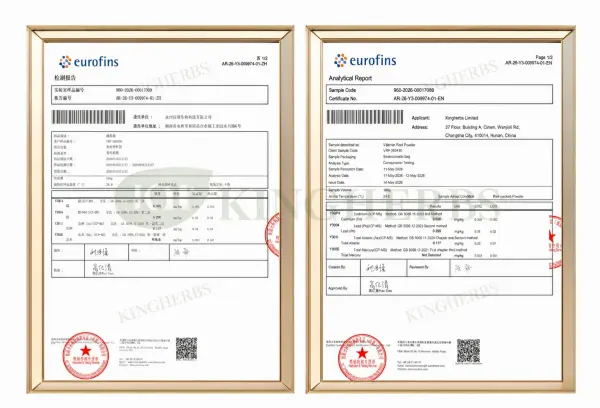
The certificate of analysis for the batch should be batch-specific and provide the product name and complete botanical name, batch or lot number, and production and retest dates. It should include the test methodologies and acceptance limits employed, the actual numerical findings (rather than just “pass” or “conforms”), and the HPLC assay or chromatographic identification result. It should also include physical, microbiological, and contaminant findings, have a laboratory approval or approved signature, and state the storage conditions and packing specifications for that particular batch.
Internal and Independent Testing
Supplier-run testing may be sufficient for regular reorders of macleaya cordata extract provided confidence has been built up via earlier shipments. Independent testing is worth the extra expense for a first purchase, a new supplier relationship, a high-value shipment, or a regulatory-sensitive application. Find a laboratory with ISO/IEC 17025 certification (where applicable), valid HPLC techniques on file, capacity to perform both botanical and contaminant testing, and a documented chain of custody for the sample (ISO/IEC 17025, International Organization for Standardization, 2017).
What Certifications and Quality Control Documents Should Suppliers Provide?
Documentation turns a verbal promise into something your QA team can actually audit.
Core Supplier Documentation
Depending on your application and destination market, request a detailed product specification sheet and a batch-specific Certificate of Analysis for every shipment. A Safety Data Sheet should be supplied when applicable, including a description of the production process and, if appropriate, declarations on allergens, GMO, irradiation, or BSE/TSE. Heavy metal, pesticide, microbiological, and residual solvent reports; stability or shelf life support data; packaging and storage statement; summary of traceability and recall procedures
EU and US Compliance Considerations
Check REACH responsibilities in the EU against any relevant food or feed standards, pesticide restrictions, and contaminant limitations for your destination country (European Chemicals Agency, 2024). Verify if the substance is for food, dietary supplement, animal feed, research, or other regulated category in the US since each category has distinct standards (U.S. Food and Drug Administration, 2024). Just because a botanical macleaya cordata extract is registered with the FDA as a facility does not imply it is allowed for all uses, so verify what category your product belongs under. Organic claims need certification under the organic program of the relevant market, and ‘natural’ is not the same as ‘organic’. CE, RoHS, and UL certifications normally do not apply to a botanical extract in itself, but may apply to connected processing equipment.
Compliance Document Review Checklist
| Document | Purpose | Buyer action |
|---|---|---|
| COA | Confirms batch release results | Match lot number and test values |
| SDS | Supports handling and transport | Review hazards and storage |
| Specification sheet | Defines agreed quality | Compare with purchase order |
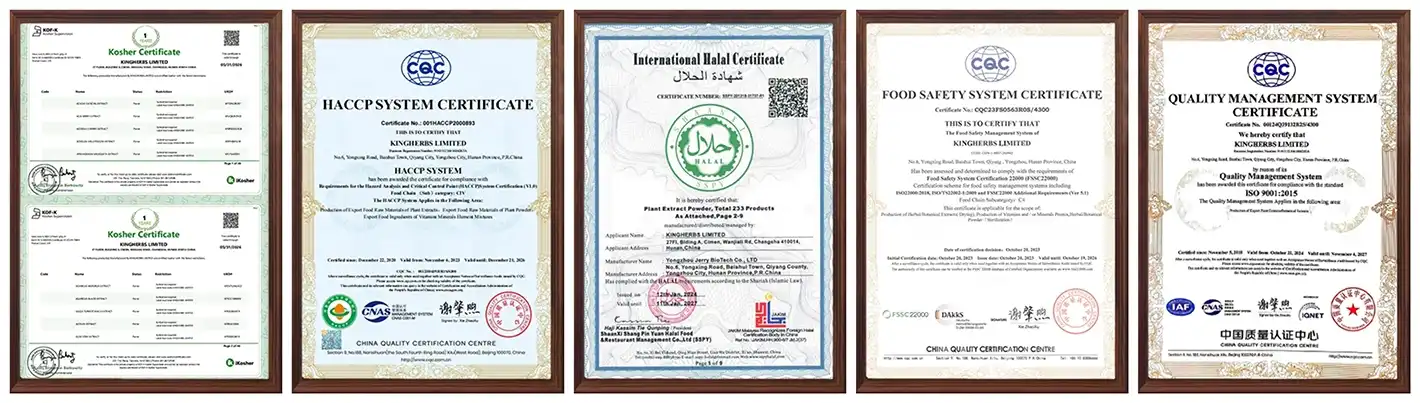
| ISO certificate | Indicates quality-system scope | Verify certificate scope and validity |
| GMP/HACCP certificate | Supports manufacturing controls | Confirm product and facility coverage |
| Organic certificate | Supports organic claim | Confirm certification body and scope |
| Non-GMO statement | Supports formulation requirements | Check for third-party verification |
| Export documents | Supports customs clearance | Confirm HS code and destination rules |
How to Evaluate a Macleaya Cordata Extract Manufacturer's Production Capacity and Traceability?
Marketing pages rarely tell you whether a company can actually scale your order without losing consistency.
Supplier Capability and Evaluation Criteria
First of all, verify if the business is really the manufacturer or if they are a contract producer, trader, or distributor, since each one has different responsibilities for quality. Next, think about the yearly or monthly production capacity, the dedicated or shared nature of the extraction equipment across goods, and the management of raw-material supply and cultivation. Check laboratory equipment and who is responsible for testing. Check what batch sizes and packaging formats are available. Ask about export experience to your target market and any alternatives for customisation of assay, particle size, carrier, or packaging.
A Real Example: Pod-Sourced Standardization in Practice
KH is a botanical ingredient company established in 1996. KH provides macleaya cordata extract from pod and standardizes it for sanguinarine concentration between 0.15% and 80% and total alkaloids between 60% and 80%, validated by HPLC on every batch. A Southeast Asian chicken feed provider, for example, had a 12% rejection rate on batches from a prior supplier, and moved to pod-sourced extract with a defined total-alkaloid acceptability range. According to internal order monitoring provided by our team, rejection was reduced to less than 2% in just two reorder cycles and the sample-to-production lead time went from around 35 days to 18 days. KH’s quality assurance lead said: “Buyers waste the most time when they assume a percentage stated means the same thing across two suppliers. “We start every new account by matching the test method first, not the price.
Traceability and Capacity Questions
Ask whether final items can be traced back to a certain lot of raw material, and if retain samples are preserved for each batch manufactured. I would appreciate a description of the process, whether the raw-material alkaloid levels fluctuate between harvests, and if the stated production capacity is for the whole botanical extract output or this particular product line. Ensure that the supplier is able to maintain the same assay range from pilot batch to commercial scale. Inquire how deviations and customer complaints are recorded and dealt with. Contact us at info@kingherbs.com.
What Should You Check Before Ordering Samples or Bulk Macleaya Cordata Extract?
A clear sourcing brief before you ever request a sample saves weeks of back-and-forth later.
Sample-Order Checklist
Before requesting or approving a sample, please write down your planned application and your destination country. Mention the botanical name and plant part you need, your target marker chemicals and test range, and the extraction solvent and macleaya cordata extract ratio you need. Please provide any needed contaminant and microbiological limits, the sample size and packing type, and whether you want a COA and test report to accompany the sample itself. Check the storage and shipping circumstances and inquire directly whether the sample is from a real commercial batch or a cherry-picked lot.
Bulk Procurement Factors
Beyond the sample stage, bulk orders involve several commercial variables worth clarifying up front.
| Factor | Questions to ask |
|---|---|
| MOQ | Is MOQ based on standard stock or custom production? KH offers sample and small-kilogram trial orders, with a 25kg commercial MOQ. |
| Price | Is the quote based on assay, dry basis, packaging, and Incoterm? |
| Lead time | Does it include testing, production, and export documentation? |
| Payment terms | Are deposit, balance, or letter-of-credit terms available? |
| Incoterms | Is the quote EXW, FOB, CIF, or DAP? |
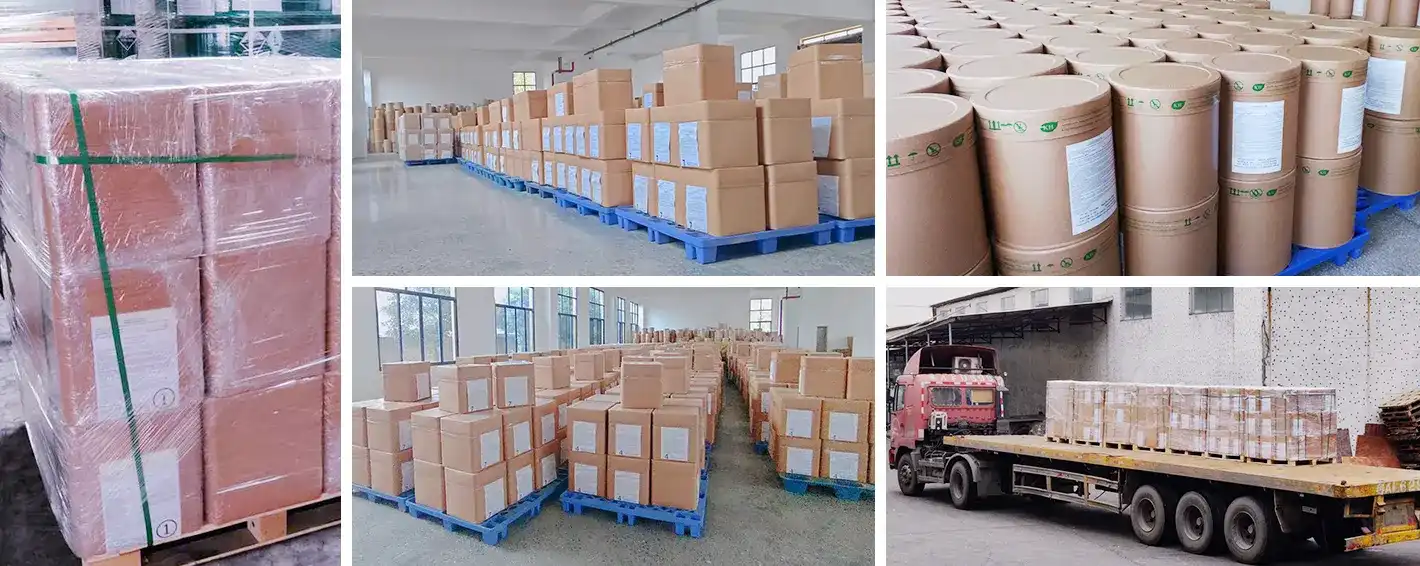
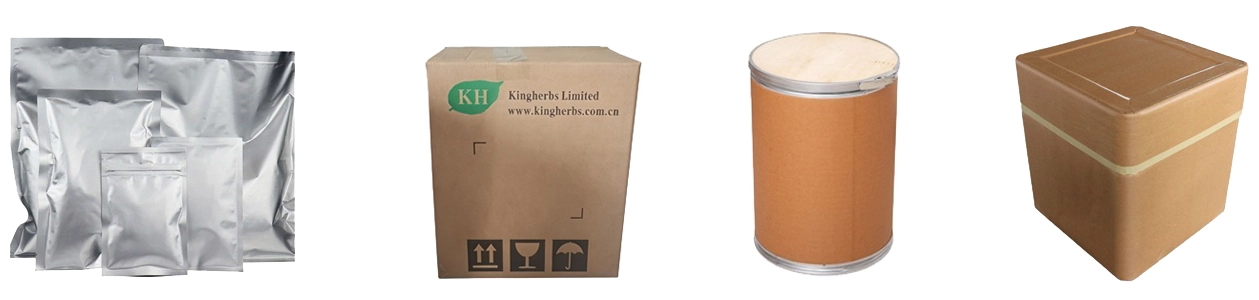
| Packaging | What drum sizes, liners, and labeling options exist? |
| Shelf life | Is it supported by stability or historical data? |
| Documentation | Are COA, SDS, origin, and customs documents included? |
Three Use-Case Scenarios
Generally, an OEM or ODM formulator will need bespoke assay, packaging, and paperwork, authorized pilot batches, and explicit change-control terms before scale-up. A distributor or importer wants uniform packaging, shelf life, export documentation, and country-of-origin paperwork. They can also require private-label or neutral-label packaging alternatives. Application performance, dosage uniformity, and supply continuity are key concerns of the end user, for example, the feed mill or manufacturing facility. Before a complete production run is committed, it is advisable to evaluate the macleaya cordata extract against the end user’s own formulation.
Bulk Ordering Risks and Mitigation
Never pay against a pro forma invoice without an associated spec sheet. Link your acceptance of products to the lot number, the related COA, and the testing standards previously accepted by you in writing. Agree in advance who will be responsible for customs clearance, import permits, and any rejected shipment. Confirm whether pricing adjustments may be caused by raw-material cost swings or by assay-grade changes.
How to Compare Macleaya Cordata Extract Manufacturers and Choose a Long-Term Supplier?
A side-by-side comparison keeps the decision based on evidence instead of whichever quote arrived first.
Price and Total Cost Comparison
Don’t only compare the reported price per kilogram when you make your final selection. Calculate the assay-adjusted cost, since a lower assay lot could be cheaper yet cost more per active unit than a higher-priced standardized grade. Include testing and paperwork expenses, packing or re-labeling charges, and freight, insurance, tariffs, and customs processing. Add in the risk and expense of a rejected shipment, your minimum order and inventory carrying cost, and the downstream cost of inconsistent material disturbing your own manufacturing process.
Final Supplier-Selection Scorecard
Thanks to a weighted scoring mechanism, the final choice is objective and not emotive. I often suggest a weighting of 30% for quality and assay consistency, 20% for documentation and compliance, 20% for manufacturing and traceability, 15% for commercial terms and logistics, 10% for technical communication, and 5% for customisation and continuity. The chosen supplier must score well on verified quality and regulatory fit, not just the lowest first quote.
Conclusion
A reputable provider of macleaya cordata extract should offer authenticated botanical identification, a clear alkaloid definition, validated HPLC testing, batch-specific COAs, contaminant test findings, and traceable manufacturing records, including necessary export documents. Compare vendors with your particular application, not a general checklist. Look at MOQ, lead time, Incoterms, customisation possibilities, and destination-market compliance. Qualify the sample, validate the test technique, approve a formal specification, and agree with your supplier on explicit parameters for acceptance and change control before ordering in quantity.
FAQ
1. What is Macleaya cordata extract?
Macleaya cordata extract is a botanical preparation made from the plant commonly known as plume poppy. It typically contains alkaloids such as sanguinarine, chelerythrine, protopine, and allocryptopine, with the exact ratio depending on plant part and extraction method.
2. What should I look for in Macleaya cordata extract?
Look for verified botanical identity, declared plant part, extraction method, marker-compound assay, contaminant limits, microbiological results, and a batch-specific COA. Match the specification to your intended food, feed, research, or industrial application rather than buying on price alone.
3. Is Macleaya cordata extract the same as sanguinarine?
No. Macleaya cordata extract is a multi-component botanical material, while sanguinarine is a single isolated alkaloid. An extract may be standardized to a certain sanguinarine level, but the two products are not automatically interchangeable in a formulation.
4. Why is HPLC testing important for Macleaya cordata extract?
HPLC testing identifies and quantifies selected alkaloid markers when run with a validated method. It lets buyers compare batches directly and confirm whether a shipment actually meets the specification agreed on before purchase.
5. What documents should a Macleaya cordata extract supplier provide?
Expect a specification sheet, batch-specific COA, SDS, contaminant and microbiological reports, traceability information, and applicable quality-system or organic certificates. EU, US, feed, food, and private-label orders often require additional paperwork beyond this baseline.
6. Can Macleaya cordata extract be used in animal feed?
It can be researched or supplied for animal nutrition use, but legal acceptability depends on the formulation, claims, dosage, target species, and destination market rules. Always complete a jurisdiction-specific feed regulatory review before commercial use.
7. How do I compare Macleaya cordata extract suppliers in China?
Confirm whether the company is a manufacturer or trader, review its quality-system scope, and check HPLC and COA documentation. Compare traceability practices, MOQ, lead time, export history, and customization capability, and request independent testing or an audit for added assurance.
8. What is the typical MOQ for bulk Macleaya cordata extract?
MOQ varies by standard stock, assay level, packaging, and customization needs. KH, for example, offers sample and small-kilogram trial orders with a 25kg commercial MOQ, so request separate MOQ figures for samples, standard bulk, and private-label packaging.
Ready to Qualify Your Macleaya Cordata Extract Supplier?
If you are comparing quotes right now, start with a sample request rather than a full bulk order. KH produces macleaya cordata extract from the pod, standardized to sanguinarine 0.15%-80% and total alkaloids 60%-80%, tested by HPLC and backed by ISO9001, FSSC22000, HACCP, Kosher, Halal, and FDA documentation. Samples typically ship within 3-5 business days. Email info@kingherbs.com with your target assay and destination country, and our team will respond with a specification sheet and batch COA for review before you commit to a commercial order.
Before requesting a formal quote, write a short sourcing brief covering your intended application and destination market, required botanical name and plant part, target sanguinarine or total-alkaloid range, required HPLC method and COA format, contaminant and microbiological limits, and your estimated annual volume with preferred packaging and Incoterm. Send that brief to info@kingherbs.com, and KH's technical team will match it against current macleaya cordata extract stock and confirm whether a custom specification is needed for your formulation.
References
1. Kew Science, Plants of the World Online (2024) — Taxonomy and accepted botanical identity for Macleaya cordata, referenced in the Botanical Identity section. https://powo.science.kew.org/taxon/urn:lsid:ipni.org:names:320209-2
2. United States Pharmacopeia–National Formulary, USP–NF (2024) — General analytical quality principles for botanical ingredients, referenced in the Specification sections. https://www.usp.org/
3. International Organization for Standardization, ISO/IEC 17025:2017 — General requirements for testing and calibration laboratory competence, referenced in the Independent Testing section. https://www.iso.org/standard/66912.html
4. FAO/WHO Codex Alimentarius Commission (2024) — General principles for food hygiene and contaminant control, referenced in the Certifications section. https://www.fao.org/fao-who-codexalimentarius/en/
5. European Chemicals Agency, ECHA (2024) — REACH obligations and EU chemical safety requirements, referenced in the EU Compliance section. https://echa.europa.eu/regulations/reach
6. U.S. Food and Drug Administration (2024) — Dietary supplement and food ingredient regulatory resources, referenced in the US Compliance section. https://www.fda.gov/food/dietary-supplements
About the author
Cathy, Manager at KH, has spent over a decade working with botanical ingredient procurement teams across North America, Europe, and Southeast Asia. She coordinates specification reviews, HPLC documentation, and export compliance support for dietary supplement, feed, and cosmetic formulation clients sourcing from KH's manufacturing operations.
Send Inquiry
Related Industry Knowledge
- Where Is Bacopa Monnieri Extract Powder Used in Supplements?
- How Does Centella Asiatica Extract Powder Support Skin Repair?
- Lotus Leaf Extract Applications in Dietary Supplements
- Blueberry Extract Powder Price and Wholesale Buying Guide
- Can White Willow Bark Extract Powder Help Reduce Chronic Discomfort?
- Cortex Phellodendri Powder: Benefits, Uses, and Dosage
- Premium Valerian Root Extract Powder for Sleep & Calm Support
- Lespedeza Capitata Extract for Plant-Based Kidney Care
- White Paeony Extract Powder for Pharmaceutical & Cosmetic Uses
- White Paeony Extract for Sensitive & Irritated Skin