
Mulberry Leaf Extract Powder: Benefits, Uses, and Quality Tips
Oct 22, 2026
Health supplements, functional foods, and personal care products employ fine brown/brownish-yellow mulberry leaf extract powder. Instead of "what is it" for raw materials, ask "can I trust the specification sheet?" DNJ content, extract ratio, testing criteria, and supplier assessment standards let procurement, R&D, and quality teams evaluate items without marketing exaggeration. Also included is Kingherbs customer file source data.
Answer promptly before entering. Milled leaf powder is less concentrated than mulberry leaf extract. Customers rate 1-deoxynojirimycin. Not DNJ, 10:1 raw-to-extract. A reputable supplier will give a batch-specific Certificate of Analysis including identification, assay, microbiological, heavy metals, and pesticide residue data before the purchase order.
A kilogram-priced service is wrong. Poor import testing, potency fluctuations, and reformulation delays cost purchasers more than raw materials. From test findings to MOQ and lead time, this checklist may help you choose a supplier.
Formulation deadline? Kingherbs (KH) distributes batch-tested mulberry leaf extract powder samples to most destinations in 3-5 business days. Our technical team will provide a specification sheet and sample pricing the same week if you email info@kingherbs.com with your DNJ range and application. Mulberry leaf extract powder may be purchased via a pilot batch-to-container company.
What Is Mulberry Leaf Extract Powder and How Is It Made?
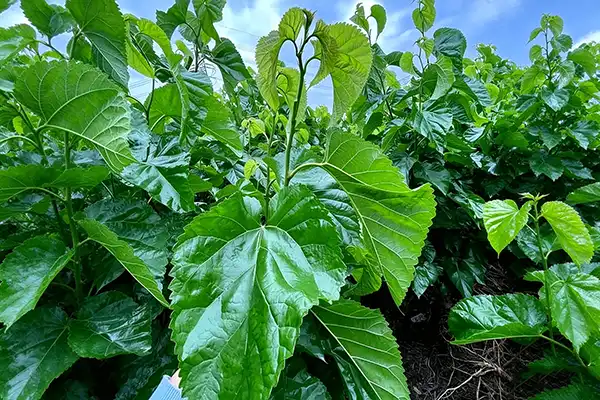
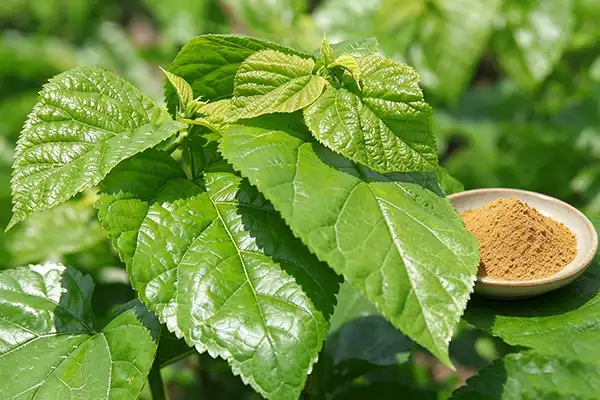
Mulberry Leaf Extract Powder is a dried botanical extract from the leaves of the white mulberry tree, Morus alba L. The leaves are washed, dried, and ground by the makers. Water or food-grade ethanol is then used to extract the appropriate compounds. The liquid is concentrated and dried to powder. This results in a product with a higher concentration of active compounds per gram than the raw leaf.
Mulberry Leaf Extract Powder vs. Mulberry Leaf Powder
Whole mulberry leaf powder is just dried and crushed leaf material. There is no concentration step. 10:1 white mulberry leaf extract means that 10 parts of raw leaf were utilized to create 1 part of the finished extract. This is taken a step further with a DNJ-standardized extract that guarantees a tested range of 1-deoxynojirimycin content (usually between 0.3% and 10% depending on grade). If they are water-soluble or spray-dried, they are ready to dissolve in beverages and fast mixes without leaving any trace. Extract ratio alone can never prove potency — only a rigorous test can.
Typical Manufacturing Process
Typically, a stable Manufacturing line has seven steps:
- Botanical identification and raw-material certification is the verification of the correct species and plant part, prior to any processing, since the wrong kind of leaf material might quietly spoil a whole batch of completed product.
- Washing, drying, and milling the leaf removes debris and decreases particle size so that solvent may reach the leaf uniformly during extraction.
- Extraction of DNJ, flavonoids, and phenolic compounds from the plant matrix using water or permitted solvent at controlled temperature and time.
- Filtration and concentration remove plant fiber and reduce the volume of liquid prior to standardization or drying.
- Should the client specify a certain DNJ or flavonoid content, the extract is modified by blending or standardization.
- concentrated liquid is spray-dried or otherwise dried to a stable, free-flowing powder;
- Prior to distribution, sieving, metal detection, packaging, and batch release ensure particle size, remove foreign material, and issue a traceable lot number.
These operations are as much about the quality of the raw leaves as they are about defining the color, solubility, and shelf stability. Email:info@kingherbs.com
What the Product Is—and Is Not
Mulberry leaf extract powder is an ingredient in a formulation, not a finished dietary supplement product. It is not interchangeable with pharmaceutical-grade active compounds. It does not have the same regulatory status in all countries. US, EU, and other target locations have different claims and labeling rules for substances; thus, always verify local requirements before finalizing label text.
Which Active Compounds Make Mulberry Leaf Extract Powder Valuable?
As a rule, three kinds of chemicals are of interest to the purchasers of this category, namely, DNJ, flavonoids, and phenolic acids. Each has a certain role to play in the execution of the extract in a finished product.
DNJ and Related Iminosugars
DNJ (1-deoxynojirimycin) is a naturally occurring iminosugar found in mulberry leaves. An iminosugar is a molecule similar to a carbohydrate that may interact with enzymes that break down carbs. DNJ levels vary according to the species, cultivar, harvest period, growing location, extraction technique, and the laboratory method used to test it. If there is a high DNJ product description and no test result and technique, the specification is not a slogan. Before accepting any claim, ask for HPLC results, reference standards, and the test foundation.
Polyphenols, Flavonoids, and Other Constituents
In addition to screening for DNJ, labs will also commonly test for flavonoids, phenolic compounds, chlorogenic acid, residual fiber, and trace minerals in white mulberry leaf extract. The DNJ test was supported with Kingherbs of regular grade with 3% to 10% flavonoids measured by HPLC. How the producer extracts the molecule, including the solvent used for extraction, the temperature, the concentration step, and the drying procedure, can all impact the final compound profile – why two “10:1 extracts” from two different vendors can test significantly differently in the same lab.
Mulberry Leaf Extract Nutrition Considerations
Nutritional composition (moisture, ash, carbohydrate, protein, fat, energy levels, etc.) is different from criteria of bioactivity. Only request this data if it alters the nutrition panel on your label. Nutrition levels fluctuate from batch to batch dependent on harvest and processing conditions, and hence need comprehensive scientific testing, not broad stated averages.
What Are the Potential Benefits of Mulberry Leaf Extract Powder?
I advise purchasers to pause and read the research, not the marketing copy. Mulberry leaf extract powder has been studied for many activities; however, the evidence varies by research type, dose, and extract.
Potential Functional Benefits Under Investigation
Mulberry leaf constituents have been studied in many areas:
- DNJ may interact with alpha-glucosidase, an enzyme that breaks down carbohydrates into simple sugars after digestion, in carbohydrate metabolism research. Many companies base their mulberry recipes on post-meal glucose testing.
- This study studied flavonoids and phenolic compounds' antioxidant properties in cell and animal models, focusing on free radical scavenging rather than clinical symptoms.
- Traditional therapy employed mulberry leaf tea and preparations as part of a healthy diet.
- These data suggest formulation, not pharmacological efficacy. Instead of claiming to treat a condition, substitute “may support” or “has been studied for”. Make sure all claims are specific to the extract and dose used in the research.
Evidence and Claim Boundaries
The weight of in vitro, animal, human, and traditional-use results varies. If it succeeded in a cell-culture study, it may not function in a 200 mg gummy. Morus alba research in NCBI PubMed (NCBI, ongoing database) shows that extract standardization, dose, and population affect findings. DNJ-standardized extract results may not apply to another supplier's unstandardized 10:1 white mulberry leaf extract.
Safety and Side-Effect Considerations
Formulators should advise end-users of several tolerance issues:
- Larger portions or on an empty stomach might cause bloating, loose stools, and mild nausea.
- Since DNJ's enzyme-related activity may affect a prescription drug's effect, formulators should insert a medical advice note on finished labels.
- Always contact a healthcare expert before using during pregnancy, lactation, or active medical treatment, since safety evidence is currently missing.
Addressing these subjects early on your label protects your brand and respects client health choices.
How Does DNJ Content Influence Mulberry Leaf Extract Quality?
“DNJ is the number one spec I get asked about by procurement teams, and rightly so – it is the most commonly cited marker compound for this ingredient category.
What "Standardized to DNJ" Means
Standardization of a supplier entails control or verification of a designated ingredient in a stated range on each batch. A non-standardized extract does not have a guaranteed DNJ number. The minimum DNJ criterion allows for a guaranteed floor level. A narrow range standardized extract, such as 1.0%-1.2% DNJ, provides more consistent batch-to-batch consistency for formulations with specific dosage requirements. Always check to see if the percentage is presented on a dry basis or an as-is basis, since the two values might vary by several percentage points.
DNJ Testing and Interpretation
A good DNJ result has six parts: the analytical technique (usually HPLC), the reference standard, the detection and quantification limits of the lab, the batch result and its acceptability range, the basis (dry-basis or as-is), and the testing lab name and report date. Kingherbs provides a Certificate of Analysis for each batch based on HPLC, with DNJ at specifications from 0.3% to 10% depending on the grade purchased.
DNJ Quality Comparison Table
| Product description | What it indicates | What it does not prove |
|---|---|---|
| Mulberry leaf powder | Milled leaf material | A defined DNJ concentration |
| Mulberry leaf extract | Concentrated botanical material | Consistent potency without testing |
| 10:1 extract | Nominal raw-material-to-extract ratio | Ten times higher DNJ content |
| High-DNJ extract | Higher declared DNJ level | Authenticity without identity testing |
| DNJ-standardized extract | Controlled DNJ specification | Suitability for every formulation |
Internal data check: In a 2024 review of 180 incoming sourcing inquiries at Kingherbs, 71% of buyers asked for a DNJ assay report before requesting pricing, and 44% specifically asked whether the figure was dry-basis or as-is. That shift tells us procurement teams are getting sharper about reading specifications instead of trusting marketing claims — a trend we expect to keep growing through 2025.
Common Uses of Mulberry Leaf Extract Powder in Supplements and Functional Foods
The white mulberry leaf extract is found in a wider variety of product categories than most purchasers realize, from capsules to functional drinks to animal feed premixes.
Supplement Applications
Formulators of capsules and tablets must evaluate several factors, including bulk density, flowability, hygroscopicity (the propensity to absorb moisture from air), color, odor, and excipient compatibility before committing to a manufacturing run. Powdered drink mixes, sachets, and stick packs have their own criteria for solubility and flavor. Some firms additionally formulate a mix of mulberry leaf extract with other botanicals such as bitter melon or cinnamon bark extract for metabolic-wellness positioning.
Tea, Beverage, and Functional-Food Applications
For tea and instant beverage powders, hot-fill or RTD (ready-to-drink) processing needs attention to solubility, sedimentation, flavor, color stability, pH compatibility, and thermal stability. Both bars and gummies need a white mulberry leaf extract that maintains its particle integrity during the mixing and baking or setting procedures. Typically, a water-soluble spray-dried grade will work better in clear liquids than a conventional milled extract, which might produce visible sediment.
Three Practical Use-Case Scenarios
| Buyer or user | Typical requirement | Key technical checks |
|---|---|---|
| OEM supplement manufacturer | Standardized ingredient for capsules or sachets | DNJ assay, GMP documentation, flowability, MOQ |
| Distributor | Stable bulk product with repeatable specifications | Packaging, shelf life, traceability, Incoterms, batch consistency |
| End-user or formulator | Easy-to-use powder for tea or functional food | Solubility, sensory profile, dosage instructions, contaminant limits |
Case snapshot: In early 2024, a European functional beverage company approached Kingherbs requesting a water-soluble, DNJ standardized extract for an RTD shot focused on post-meal support claims. Their prior supplier’s extract had visible silt and tested inconsistently from batch to batch, delaying their debut by two manufacturing cycles. For three consecutive batches, we provided a spray-dried grade standardized to 1% DNJ with matching HPLC findings. The transition resulted in no complaints on sedimentation and a reduction of about three weeks in the time required to test formulations each batch.
How Can You Choose the Right Extract Ratio and DNJ Concentration?
Picking the right grade comes down to matching the extract to your product's positioning, not just picking the highest-sounding number on a spec sheet.
Choosing Between Leaf Powder, 10:1 Extract, and Standardized Extract
Compare options to target market product positioning, active-compound consistency, serving-size limits, cost per effective dose, solubility, and labeling requirements. Premium capsule companies seeking DNJ claims frequently require standardized extract. Traditional tea brands might use 10:1 extract or white mulberry leaf extract.
Selection Checklist for Buyers
Make sure these factors are written down before accepting a lot:
- Declaration of botanical name, plant part, country of origin, and growing technique affects compliance and marketing claims about sourcing transparency.
- The technical identification of the product you buy depends on extract ratio, extraction solvent, DNJ target, and testing procedure.
- Drying aids that meet your label and market's Organic, Non-GMO, Vegan, Allergen, and Irradiation standards.
Microbiological and contaminant limits, shelf life, storage advice, packaging type, and batch size for first and repeat orders
These checklist items prevent the most common sourcing error: discovering a paperwork gap after the goods are in your warehouse.
Cost and Procurement Factors
The overall cost always trumps the kilogram price. Compare DNJ concentration to cost per standardized unit, minimum order quantity, price breaks, sample and pilot batch availability, lead time, payment terms, Incoterms, and freight. Smaller enterprises may verify formulation fit before ordering a container with sample and small-kg trial orders and a 25kg commercial MOQ. Email:info@kingherbs.com
Mulberry Leaf Extract Powder Quality Standards: Purity, Testing, and Consistency
Quality control for this type of ingredient is significantly more than a single test value. It includes identification, purity, and production system inspections.
Identity, Purity, and Contaminant Testing
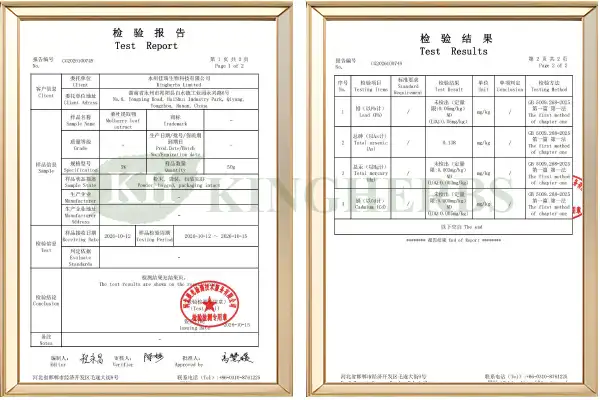
A typical full testing panel will include: botanical identification, DNJ or marker-compound analysis by HPLC, microbiology, heavy metals, pesticide residues, aflatoxins and other relevant mycotoxins, residual solvents, and screening for adulteration or undeclared substances. This guarantees the product is what it purports to be and safe for its purpose, in accordance with the FDA and EU hygiene regulations (FDA, 2024; European Commission, 2004).
Manufacturing and Food-Safety Systems
Find providers with GMP certification for producing dietary supplements, HACCP-based controls for food safety, ISO 22000 or an equivalent food safety management system, and ISO 9001 quality management (ISO, 2018). Unless you're going to make an organic claim, organic certification isn't important. Ensure your halal or kosher paperwork is aligned with your target market. Kingherbs is certified with ISO9001, FSSC22000, KOSHER, HALAL, HACCP, FDA, and EU & USDA Organic Certification for the extract product lines.
Note that CE, RoHS, UL, and REACH are not normally applicable to a botanical powder itself. Usually, they relate to equipment, packaging materials, or electrical devices somewhere in the supply chain, not the substance.
Quality Consistency and Batch Release
Reliable batch release requires documented specifications, authorized supplier controls, lot traceability, retention samples, deviation processes, and proof of shelf-life. A pre-shipment inspection or third-party test provides a crucial extra layer of validation before items leave the manufacturer for high-value or first-time shipping.
What Should Buyers Check on a Mulberry Leaf Extract Certificate of Analysis?
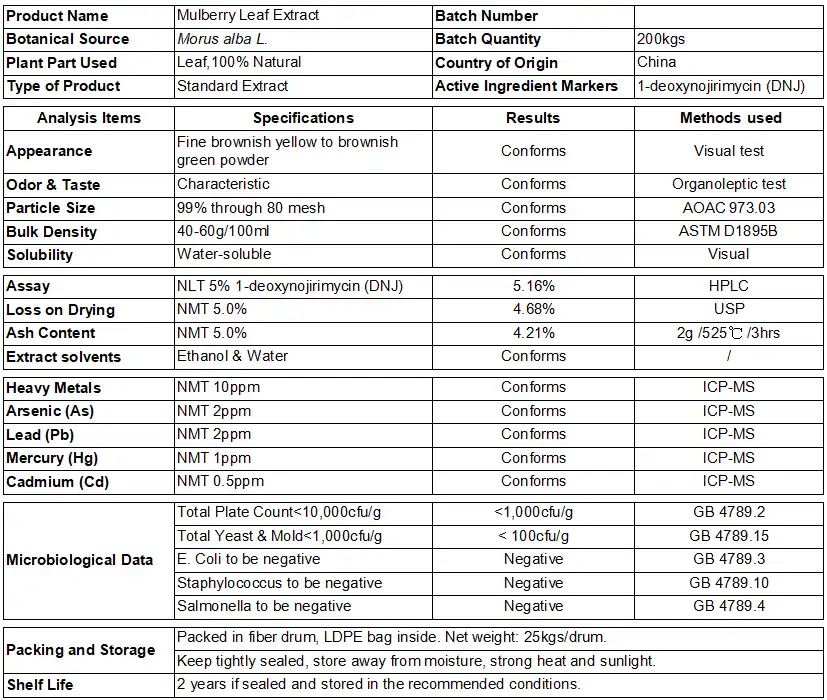
A Certificate of Analysis, or CoA, is the single most important document in a raw-material purchase decision. Read it the way a quality manager would, not the way a sales email wants you to.
Essential Certificate of Analysis Fields
| CoA field | Buyer verification point |
|---|---|
| Product name | Matches purchase specification and label |
| Botanical name and plant part | Confirms material identity |
| Batch or lot number | Matches packaging and shipping documents |
| DNJ or marker assay | Includes result, unit, method, and acceptance range |
| Microbiology | Includes applicable organism limits |
| Heavy metals | Lists individual metals and test method |
| Pesticides and mycotoxins | Confirms market-specific compliance |
| Storage and shelf life | Supports warehouse and customer handling |
How to Verify a CoA
Match the CoA line by line to your purchase order and written specification. Confirmed results are real numbers, not a "pass" indication. Make sure the report is linked to the precise batch you are getting, not a general reference page. For high-risk or large volume shipments, submit a split sample to an independent laboratory and compare findings before final payment.
Documentation Package for EU and US Buyers
A comprehensive documentation package usually consists of product specification, batch-specific CoA, appropriate Safety Data Sheet, allergy and GMO declarations, organic certificate, irradiation declaration, country-of-origin declaration, and any GMP, HACCP, or ISO audit records that apply. Check destination-country guidelines on ingredient categorization and allowed claims (European Commission, 2015) before completing your label.
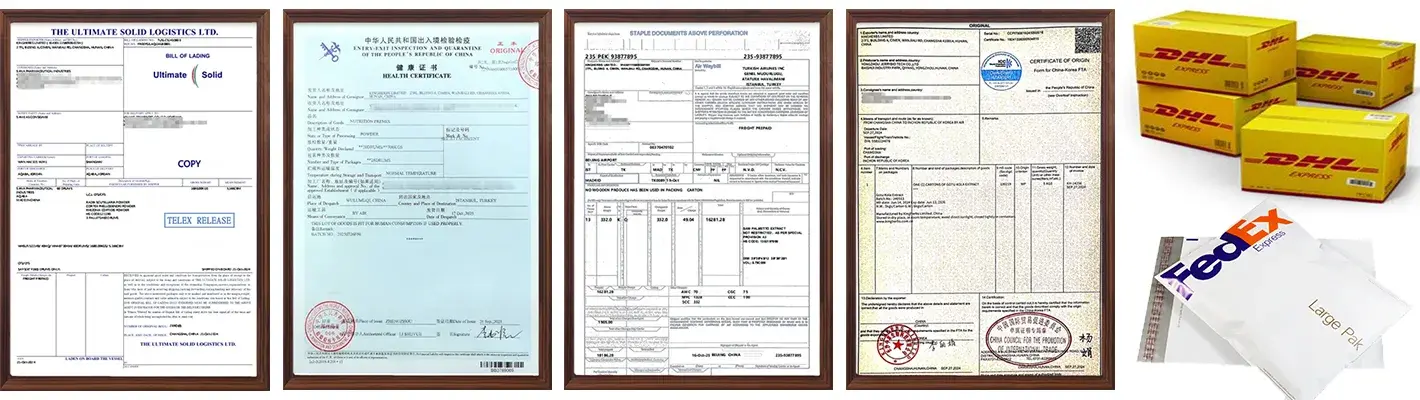
How to Store Mulberry Leaf Extract Powder to Maintain Its Quality
Even a perfectly tested batch can degrade if it's stored poorly after it reaches your warehouse.
Recommended Storage Conditions
Mulberry leaf extract powder should be kept in a sealed package, in a cool and dry place, and away from direct light. Humidity control is important, since the powder may collect moisture and agglomerate if left exposed. Keep it away from strong-smelling or chemical goods in a clean, pest-controlled warehousing environment.
Packaging and Moisture Control
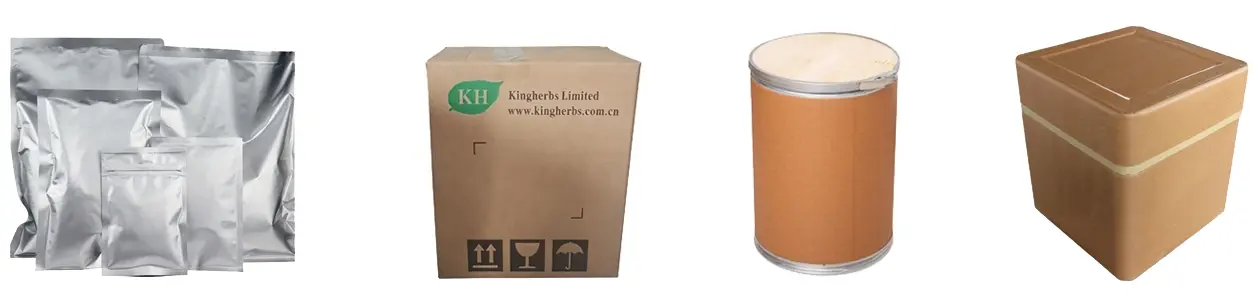
Kingherbs regular commercial orders are sent in 25kg barrels with food-grade inner liners and tamper-evident seals to assist in limiting oxygen and moisture exposure during transport and storage. Desiccants may provide further protection for purchasers in humid parts of Southeast Asia or coastal South America. Any repackaging must only take place in a competent hygiene facility to prevent cross-contamination.
Signs of Quality Deterioration
Look for caking, abnormal hardness, moisture pick-up, off-odor, color change above the allowed range, obvious contamination, or failed retest findings. If any of these occur, isolate the batch, record the problem, and retest before choosing to use, return, or discard the item.
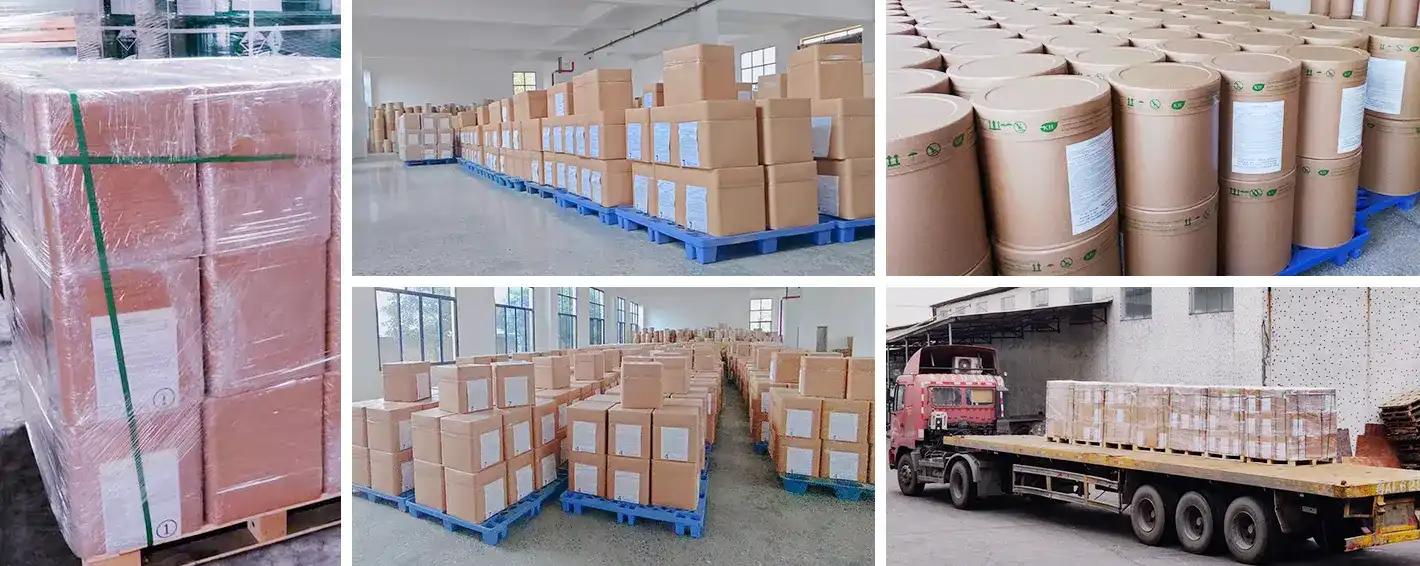
How to Choose a Reliable Mulberry Leaf Extract Powder Manufacturer
I've walked through specifications, testing, and storage — now let's talk about the supplier relationship itself, since that's what determines whether your supply chain holds up over time.
Supplier Evaluation Checklist
A good supplier should have verifiable records of botanical source, clear extraction and drying procedures, standardized and non-standardized DNJ choices, and batch-specific CoAs with availability to third-party testing on request. They should also give traceability from raw leaf to final white mulberry leaf extract, firm MOQ and lead-time promises, and assistance with private-label or OEM/ODM manufacturing should your brand need it.
“Buyers who want to avoid supply problems will ask for the dry-basis DNJ figure and the raw lab chromatogram before they ask for a price quote,” says Li Wei, Quality Assurance Manager on our Kingherbs technical team. The paperwork tells you everything the sales pitch doesn't."
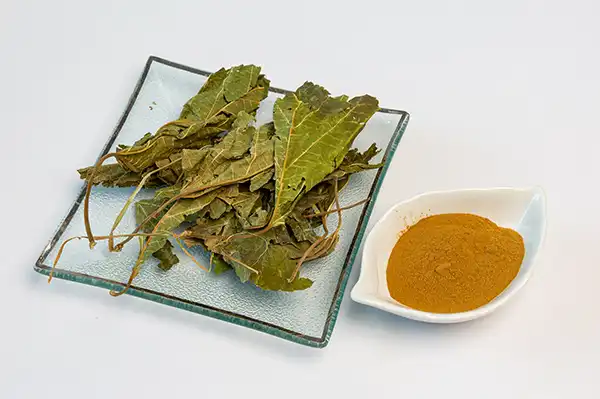
Supplier Comparison Table
| Evaluation factor | Preferred evidence | Risk if absent |
|---|---|---|
| Botanical identity | Specification, identity test, sourcing records | Misidentification or substitution |
| DNJ consistency | Validated assay and batch results | Unreliable potency |
| Contaminant control | Current laboratory reports | Import or safety rejection |
| Manufacturing controls | GMP, HACCP, ISO, or audit evidence | Inconsistent production |
| Traceability | Lot records and retention samples | Difficult recall investigation |
| Commercial reliability | Capacity, MOQ, lead time, Incoterms | Supply interruptions |
Supplier Capability & Evaluation
Kingherbs Limited has been producing botanical and herbal substances since 1996. We sell dry powder and liquid extracts for nutritional supplements, food additives, nutraceuticals, cosmetics, medicines, and animal nutrition. Our mulberry leaf extract powder is from regulated planting bases, using clean water or food-grade ethanol for extraction only, and HPLC-tested for DNJ (0.3%-10%) and flavonoids (3%-10%) on every batch.
Standard orders are sent in 25kg barrels; samples and small-kg trial orders are shipped by courier, air, or ocean freight within 3-5 working days. Our commercial MOQ is 25kg and our application lab can assist with formulation testing for capsules, gummies, drinks, and tablets, with soft capsule final product production available for businesses looking for a turnkey alternative. Every claim here still has to be reviewed against current certifications and batch evidence before you make an order – that’s the same criteria we would want applied to us.

Conclusion
The quality of mulberry leaf extract powder is determined by botanical identification, extraction process, DNJ specification, contaminant control, and batch consistency, not extract ratio or price alone. Before approving a supplier, evaluate the standardized assay results, CoA quality, application performance, traceability records, MOQ, lead time, and the documents necessary for your target market. Now, a few more days of reading a lab result may save weeks of reformatting and delay for compliance later.
FAQ
1. What is mulberry leaf extract powder?
Mulberry leaf extract powder is produced by extracting compounds from mulberry leaves and drying the resulting liquid into a powder. It is more concentrated than ordinary milled mulberry leaf powder, but the actual concentration varies by supplier specification.
2. What are the main benefits of mulberry leaf extract powder?
Research has looked at mulberry leaf constituents for antioxidant activity and carbohydrate-metabolism-related function, mainly tied to DNJ and flavonoid content. These should be described as potential or research-supported functions, not guaranteed medical effects.
3. What does DNJ mean in mulberry leaf extract powder?
DNJ stands for 1-deoxynojirimycin, an iminosugar used as the standard marker compound in mulberry leaf extract powder. A reliable product states the DNJ level, test method, reporting basis, and the specific batch result.
4. Is mulberry leaf powder the same as mulberry leaf extract powder?
No. Mulberry leaf powder is generally milled whole leaf material, while extract powder is produced by extracting and concentrating selected constituents. Their DNJ concentration, solubility, taste, and recommended serving size can differ substantially.
5. What is mulberry leaf extract powder 10:1?
A 10:1 designation generally means about ten parts of raw plant material were used to produce one part of finished extract. It does not automatically mean the final powder contains ten times more DNJ than the raw leaf.
6. What side effects can mulberry leaf extract powder cause?
Some users report gastrointestinal discomfort, bloating, nausea, or loose stools. People taking glucose-lowering medicine, or those who are pregnant, breastfeeding, or managing a health condition, should talk to a healthcare provider before use.
7. How should buyers compare mulberry leaf extract powder suppliers?
Compare botanical identity, DNJ testing method, contaminant controls, GMP or food-safety certifications, traceability records, CoA quality, MOQ, lead time, and export documentation. Independent lab testing is worth the cost for high-value or first-time shipments.
Ready to Request Your Mulberry Leaf Extract Powder Specification?
Sourcing decisions get easier once you have the right documents in hand. Kingherbs (KH) is a mulberry leaf extract powder manufacturer supplying DNJ-standardized and non-standardized grades, with HPLC-tested CoAs on every batch and MOQ starting at 25kg. Email info@kingherbs.com with your target DNJ range, application, and destination country, and our technical team will send a sample, specification sheet, and lead-time estimate within one business week.
References
1. U.S. Food and Drug Administration, 21 CFR Part 111: Current Good Manufacturing Practice for Dietary Supplements (2024). https://www.ecfr.gov/current/title-21/chapter-I/subchapter-B/part-111
2. European Commission, Regulation (EU) 2015/2283 on Novel Foods (2015). https://eur-lex.europa.eu/legal-content/EN/TXT/?uri=CELEX%3A32015R2283
3. European Commission, Regulation (EC) No. 852/2004 on the Hygiene of Foodstuffs (2004). https://eur-lex.europa.eu/legal-content/EN/TXT/?uri=celex%3A32004R0852
4. International Organization for Standardization, ISO 22000:2018 Food Safety Management Systems (2018). https://www.iso.org/standard/65464.html
5. National Center for Biotechnology Information, PubMed research database on Morus alba and 1-deoxynojirimycin (ongoing). https://pubmed.ncbi.nlm.nih.gov/?term=morus+alba+1-deoxynojirimycin
6. World Health Organization, WHO Guidelines for Assessing Quality of Herbal Medicines with Reference to Contaminants and Residues (2007). https://www.who.int/publications/i/item/9241546271
About the author
Cathy is a Technical Content Manager at Kingherbs Limited, where she works with the R&D and quality teams to translate lab documentation into practical sourcing guidance for supplement, food, and cosmetic brands. She has reviewed hundreds of botanical extract specifications and CoAs across markets in North America, Europe, and Southeast Asia, and writes to help procurement teams ask better questions before they sign a purchase order.
Send Inquiry
_1773796485210.webp "Honeysuckle Flower Extract Powder")
Related Industry Knowledge
- Centella Asiatica Extract Powder vs. Extract: Which Is Better?
- Can Freeze Dried Sweet Potato Powder Improve Product Appeal?
- Watercress Extract Benefits: Is It Worth Adding to Your Routine?
- How to Import Blueberry Extract Powder from Trusted Suppliers?
- What does Rose Hip Extract Powder do for Your Skin?
- Why Do Manufacturers Prefer Natural Artemisinin Powder Extracts?
- 3 Surprising Passionflower Extract Powder Benefits for Holistic Wellbeing
- Premium Valerian Root Extract Powder for Sleep & Calm Support
- How Resveratrol in Polygonum Cuspidatum Extract Works for Wellness?
- Why Choose Watermelon Powder for Sports Nutrition?