
Can Watermelon Powder Enhance Your Smoothie and Supplement Line?
Nov 13, 2026
If you are buying raw ingredients for smoothies, drink mixes, or supplement blends, you absolutely want a clear answer. Watermelon powder: does it truly do anything for the completed product, or is it simply a marketing add-on? So, to conclude, sure — if the raw material is to the proper specs. Watermelon powder is the fruit, or juice, of watermelon that has been dried and processed into a stable powder that preserves its color, flavor, and minerals for months instead of days. In this post, we'll examine how it works in smoothies and supplements, the nutrients it delivers, and how purchasing teams may check quality before a commercial buy.
Quick Summary for Busy Buyers
Important details should be out front for readers who want to analyze quickly. Procurement and R&D teams - here’s what you should know before you look at a sample.
- Watermelon powder is watermelon that has been dehydrated so that it is a more concentrated, shelf-stable ingredient. Depending on the moisture level and barrier packing , watermelon powder will last for 12 to 24 months if done well.
- Depending on the fruit fraction used and the drying process during production, it may include fruit sugars, fiber, minerals, natural pigments, and citrulline.
- Powdered ones are also easier to use in smoothies, have better consistency and storage stability, and are accessible year-round, unlike fresh watermelon, which is harvested for a limited time.
- Freeze-dried watermelon powder usually has greater taste and better color than fresh fruit. Spray-dried watermelon powder is generally cheaper at commercial scale.
- A whole fruit powder is neither a watermelon juice powder or a standardized citrulline ingredient, which have different nutritional and solubility qualities.
- Buyers should then need data on moisture, water activity, solubility, microbial and pesticide residues before approving a supplier for industrial use.
- Commercial sourcing is dependent on demand, MOQ, lead time, packaging type, and shipping circumstances such as FOB or CIF.
These are the main difficulties, and they are solved quickly. Below is an explanation of the logic, facts, and supplier check for each section:
What Is Watermelon Powder and How Is It Made?
Definition, Scope, and Common Product Types
Watermelon powder is dried watermelon fruit or dried and crushed watermelon juice and pulp into a fine powder. It’s not genuine watermelon, and it’s not just watermelon juice powder or a standardized L-citrulline supplement. Buyers should also be aware that it is not automatically organic, non-GMO, or certified for every health claim without the supporting paperwork.
Typical product categories include whole fruit powders of the surrounding pulp and rind meat, juice powders from squeezed juice, freeze-dried powders, spray-dried powders, and carrier-based vs. carrier-free forms. Whether you use a tablet press or a drink-mix blender, each kind of smoothie base is distinct. It is more important that the product type is suitable for the application than to pursue the lowest price per kilogram.
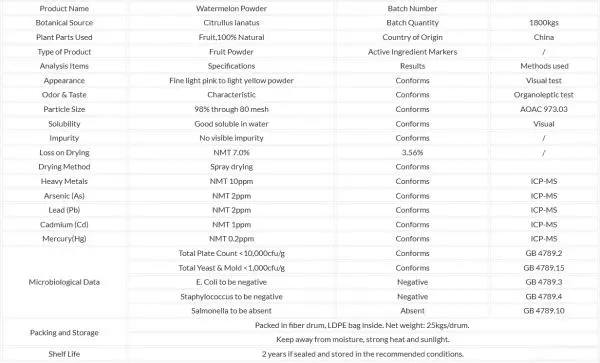
Specification:
Product Name: Watermelon Powder
Botanical Source: Citrullus lanatus
Appearance: Fine light pink to light yellow powder
Plant Part Used: Fruit
Certifications: ISO9001, FSSC22000, KOSHER, HALAL, HACCP, FDA, ORGANIC(EU), ORGANIC(USDA)
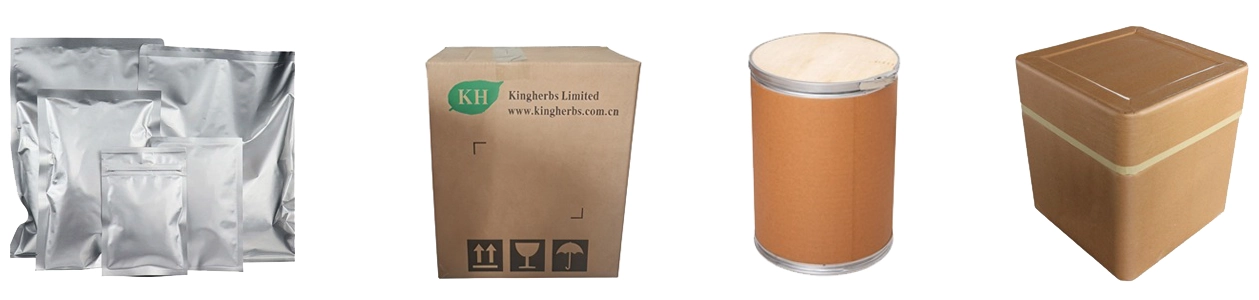
Packing Size: 25kg/drum
Transportation: Courier, Air, Ocean
MOQ: sample and small kgs trial order available, commercial order MOQ 25kg
How Watermelon Powder Is Made
Manufacturing is a systematic process that aims at the maximum quality and performance. Smart buyers know what to look for in each step and may ask better questions in supplier audits.
- Picking, washing, and sorting out damaged or overripe units.
- Cut it, remove seeds, and then produce pulp or juice as per your demands.
- Proven heat drying, such as freeze drying, spray drying, or other methods.
- Milling, sieving, mixing, and metal detection for the right particle size.
- Packaged to ensure shelf life by controlling humidity and moisture.
- But it is extremely significant, the process flow, since it enables you to regulate at each level. If a supplier packs in a humid atmosphere or can avoid metal detection, the risk of contamination and caking increases before the powder ever reaches your facility.
- Ingredients and Label Declaration Considerations
The final powder may comprise watermelon fruit solids, natural fruit sugars, dietary fiber, and in certain formulations, transporters like maltodextrin or gum acacia. Products for carrier-based applications may incorporate flow agents, if authorized by legislation in the target market. Before accepting any food, ask for the full ingredient information and allergy disclosure. Carriers that are untagged may need to be relabeled after the production cycle.
What Nutrients and Natural Compounds Does Watermelon Fruit Powder Contain?
Typical Watermelon Powder Nutrition
Watermelon is around 91% water (USDA FoodData Central, 2023), the remainder being natural sugar, a little amount of fiber, potassium, and precursors of vitamins A and C. When they are dried, the nutrients are concentrated. A gram of watermelon powder contains far more sugar, fiber, and minerals than a gram of fresh watermelon. The values will vary with cultivar, ripeness at harvest, and drying process used; therefore, nutritional data should always be gathered per 100 grams and per projected portion size and not from a general fruit table.
Natural Pigments and Bioactive Compounds
Formulators seeking watermelon constituents are especially interested in lycopene, L-citrulline, phenolic compounds, and the natural red to pink hues. Lycopene is a carotenoid antioxidant, which is responsible for the red color of watermelon flesh. L-citrulline is an amino acid that has been researched for its function in the production of nitric oxide, which enhances blood flow during exercise. If batch testing is unable to verify the actual amount of citrulline or lycopene, then a whole fruit powder should not be promoted as a standardized active ingredient since concentrations may vary by cultivar and drying temperature.
How to Substantiate Watermelon Powder Benefits
Nutrient content is not a marketing promise, and authorities handle it differently. Before you submit a claim, ask your provider for the following:
- The CoA is not a generic specification document that is repeated for numerous batches, but it is customized to the batch for nutrients and active substances.
- Validated test protocols (preferably AOAC International methodology) that allow lab results to be repeated and defended during a regulatory evaluation.
- Nutrient and color shelf-life data for 6, 12, and 18 months under specified storage conditions.
- A written statement of the claims that the batch may lawfully carry in your intended market (EU and US claim rules differ).
- Supporting documentation such as this shields your brand against a false claim recall. They also provide your compliance personnel the paperwork to give them the ability to quickly respond to a store or auditor concern.
How Can Watermelon Powder Improve Smoothie Flavor, Color, and Nutrition?
Flavor and Color Contributions
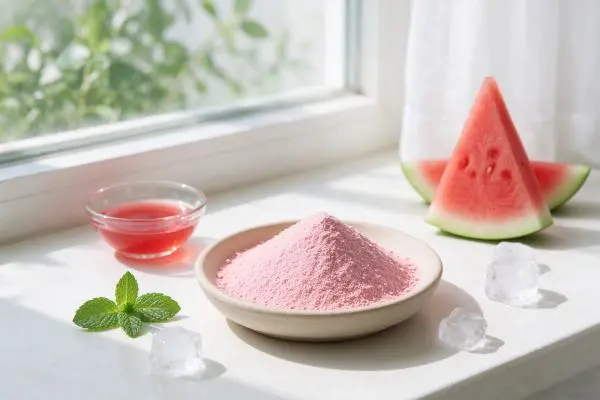
Properly processed watermelon powder will taste like fruit and will be pink to scarlet, which quickly tells the client that it is watermelon. In the end, the taste and appearance are a function of the variety, the drying temperature, the level of oxidation, and the carrier. Powder dried too hot might taste flat or a little overdone, and a batch not properly stored can change from pink to a drab tan in a few weeks. If you only taste the raw powder, you won't get the impact of the sugar, acid, and protein in the final smoothie mix that affects a taster's perception of color and flavor. Do a sensory panel on the smoothie base itself.
Smoothie Formulation Advantages
Watermelon powder has obvious output benefits compared with raw watermelon. Fresh fruit is only available in season at certain times of the year and has to be kept cold, but it adds water to the smoothie mix, which reduces shelf life. The powder really helps you to lose weight.
- Fresh fruit can last a few days. A neatly packed powder in a cool, dry environment may last 12 months or more.
- You have a set gram weight instead of an estimated cup of chopped fruit, so it’s easier to control how much fruit you use. This improves the consistency of the recipe from batch to batch.
- You don’t have to wash, cut, or juice on the factory floor before combining, which makes it faster to get ready.
- It is far less dependent on the cold chain, reducing freight costs and preventing spoilage of export goods.
- The dried powder may be purchased any time of the year, not dependent on the place of the harvest like fresh fruit is.
- These benefits mean that many smoothie and drink mix companies no longer have to worry about their supplies in the off-season. The powder is also compatible with electrolyte mixes, herbal extracts, and dairy and plant bases, allowing for a wider choice of formulations.
Smoothie Formulation Checklist
| Criterion | Questions to Verify |
|---|---|
| Flavor | Is the profile natural, sweet, acidic, or bland after storage? |
| Color | Does the color stay stable during shelf-life testing? |
| Solubility | Does the powder disperse without heavy sediment at the bottom? |
| Texture | Does it create grit, excess foam, or unwanted thickening? |
| Sweetness | Does it change the sugar and calorie declaration on the label? |
| Stability | Does performance hold at the product's intended pH and storage temperature? |
Why Is Watermelon Fruit Powder a Versatile Ingredient for Functional Beverages?
Beverage and Supplement Applications
Watermelon fruit powder works well in smoothies, but also works great in hydration mixes, before and post-workout blends, meal replacement shakes, protein powders, candies, sachets, stick packs, and flavored sports beverages. That’s why teams buying for supplement brands, drink firms, and contract producers put this item high on their list when they require natural color and flavor systems.
Three Commercial Use-Case Scenarios
People desire multiple forms of the same basic resource. “Time is saved when the right situation and supplier interaction are matched.”
- A Brand OEM requires a powder specification that can be used and reused, private label packaging, formulation support, and compliance label claims that are the same throughout many production runs and do not need to be reformed each time.
- A distributor requires a constant supply, consistent documentation, export packaging, verified shelf-life, and a variety of pack sizes to satisfy the diverse demands of its customers.
- For a manufacturing plant producing goods for end customers, the requirements include precise, predictable dosing, simple handling on current equipment, complete batch tracking, and dependable dispersion in the existing mixing or filling line.
- If you know which situation applies to your company, you may ask the proper questions of the supplier from the outset, rather than find out after the event that there are difficulties with the packing or documentation.
- Formulation and Packaging Variables
- The quantity of sugar, the fruit-equivalent location on the label, and the portion size are determined by the amount of powder used. Powders may tend to agglomerate during storage or filling because they take up water from the air. “When the packaging is a sachet, pouch, drum, or bulk bag with nitrogen flushing or moisture-barrier film, the investment is protected all the way through the supply chain.” Because the film operates with automatic filling lines.
Can Watermelon Powder Support Hydration and Sports Nutrition Formulations?
Watermelon Powder and Hydration Formulas
Watermelon powder provides the natural flavor of watermelon, plus a little potassium and magnesium. But sodium alone does not make the powder a complete hydration solution. Fruit powder is widely used as a foundation for hydration beverages; however, they usually need additional sources of electrolytes. You can't substitute watermelon powder for an oral rehydration solution or other medically supervised products since they are created and tested to different standards.
Sports Nutrition Positioning
Watermelon-derived material is often utilized in sports nutrition for things like activity beverages, healing mixes, pre-workout products, and fruit-based electrolyte powders since it tastes pleasant and is linked to L-citrulline. The quantity of citrulline might vary widely across vendors and batches. If a company wishes to advertize a citrulline-related advantage, they should run the assay on that particular batch of whole fruit powder, not on typical fruit averages.
Claim and Safety Review
Before you approve it, make sure the wording on the sports nutrition label fits the serving size nutrition facts and any rules that apply to your target market. The rules for claims in the EU are given in Regulation (EC) No 1924/2006 (European Commission, 2006). It states that nutrition and health claims can only be substantiated by scientific evidence. In the US, FDA labeling, dietary supplement guidelines, and facility compliance are covered under 21 CFR Part 111 (FDA, 2024). If you can’t prove it, don’t talk about sports performance, blood flow, treating dehydration, or any other medical consequence in anything but accurate terminology.
Watermelon Fruit Powder Applications in Dietary Supplements and Nutritional Blends
Supplement Formats and Recommended Uses
Watermelon fruit powder is also used outside of liquids in capsules and tablets where powder density and flowability influence fill weight accuracy, and in sachets and drink mixes where solubility influences consumer happiness. It also appears in candies, where the moisture and taste balance requires pilot testing, and in protein and greens powders, where it offers natural sweetness and color without the need for artificial ingredients.
Watermelon Powder Versus Standardized Active Ingredients
| Material | Primary Value | Standardization | Typical Use |
|---|---|---|---|
| Whole-fruit watermelon powder | Fruit flavor, color, and nutrients | Usually variable | Smoothies and food blends |
| Watermelon juice powder | Juice solids and flavor | Variable to moderate | Beverage powders |
| Standardized citrulline ingredient | Defined active content | Higher | Sports nutrition formulas |
| Watermelon flavor system | Flavor only | Flavor-system specific | Beverages and confectionery |
Labeling and Formula Development Questions
Prior to deciding on a recipe, find out whether the end result will fall under the classification of a food ingredient, a dietary supplement ingredient, a flavoring component, or an organic ingredient. Each technique has different serving size restrictions, carrier disclosure requirements, and formats for the nutrition panel. Get your regulatory team involved early to confirm them; a late label change post-production may push a launch back weeks.
How Does Spray-Dried Watermelon Powder Compare with Freeze-Dried Powder?
Spray-Dried Versus Freeze-Dried Comparison
| Factor | Spray-Dried Watermelon Powder | Freeze-Dried Watermelon Powder |
|---|---|---|
| Processing | Atomized liquid dried with hot air | Frozen material dried under vacuum |
| Cost | Generally more economical at scale | Generally higher per kilogram |
| Throughput | High industrial throughput | Typically slower batch cycles |
| Flavor retention | Good, depending on process control | Often closer to fresh fruit |
| Heat-sensitive compounds | May see greater thermal exposure | Usually better protected from heat |
| Solubility | Often good when properly formulated | Depends on final particle structure |
| Carrier use | More commonly used | May be carrier-free or low-carrier |
| Best fit | Cost-sensitive beverage production | Premium sensory or nutrient positioning |
Choosing the Appropriate Drying Method
Spray drying is used when you want a low cost per kg, huge production volumes, uniform powder flow on filling equipment, and rapid beverage line processing. Freeze drying is indicated when sensory quality of the fresh fruit is crucial, when a premium product position is required, when thermal exposure should be reduced to safeguard heat-sensitive compounds, and when production batches are smaller and higher value with less care about cost per kilogram.
Cost and Performance Trade-Offs
Price per kg should not be the primary factor in sourcing selections. To get the same taste and color targets, a lower-cost spray-dried watermelon fruit powder lot with a high carrier % may need a greater dose than a more concentrated freeze-dried lot. For example, one beverage customer, in an internal evaluation of reformulation projects, was able to cut the dose by 22% to get the same sensory score by converting from a 60%-carrier spray-dried powder to a low-carrier freeze-dried powder. The greater price per kg in one manufacturing cycle was mitigated by this. Don’t just look at the price per unit they are promoting. Always compare fruit solids, yield, freight density, and cost of rework.
What Should Manufacturers Consider When Formulating with Watermelon Powder?
Technical Formulation Factors
Before scaling up from a trial batch, formulators should consider moisture content and water activity, particle size and sieve distribution, bulk density and flowability. Solubility, dispersibility, and sedimentation behavior are crucial for liquid applications. pH compatibility and interaction with proteins, minerals, acids, and sweeteners decide whether the final color and flavor survive the whole shelf life of the product.
Common Risks and Mitigation
Most formulation failures trace back to a handful of repeat issues. Knowing them in advance shortens troubleshooting time during a pilot run.
| Risk | Possible Cause | Mitigation |
|---|---|---|
| Caking | Moisture absorption during storage | Use moisture-barrier packaging and controlled warehouse conditions |
| Color fading | Oxidation from light or heat exposure | Test opaque packaging and antioxidant protection systems |
| Sedimentation | Large or poorly soluble particles | Validate particle size and correct mixing sequence |
| Flavor inconsistency | Crop variation or process drift | Use written batch specifications and sensory release criteria |
| Microbial failure | Poor hygiene or elevated water activity | Require HACCP controls and independent batch testing |
| Label mismatch | Undeclared carrier or unsupported claim | Review the formula, CoA, and local labeling rules together |
Pilot Trial and Scale-Up Plan
A well-defined method for scale-up reduces the chances of a commercial run going wrong. Kingherbs recommends a laboratory bench test to demonstrate basic compatibility, a pilot production trial at a larger but still controlled volume, an accelerated or real-time stability study to project shelf life, a packaging-line trial to demonstrate equipment compatibility, and first commercial batch verification to the original specification. The mixing order, temperature, shear, hydration time, and final sensory ratings are recorded at each stage, providing a data trail that may aid with future re-orders without having to go through the complete trial process.
Case study: Shortening reformulation time for a European smoothie brand
In 2024, a mid-sized European manufacturer of smoothies contacted Kingherbs. Their former supplier of spray-dried watermelon had sent them three consecutive batches that differed in color, two of which had passed internal sensory review. The R&D director at the firm sought a pink that would stay in the market for six months and not use any synthetic color additives.
Kingherbs also tested their freeze-dried watermelon powder with a reduced carrier ratio side by side. Before dispensing, batch-specific HPLC analysis was conducted to check the pigment and moisture levels. In accelerated storage testing, the client’s pilot batch showed excellent color stability for 9 months vs. 4 months for the prior supplier’s material. For the initial shipment, the CoA and the written spec were in accord; therefore, no rework was required. Time to reformulate and get permission was reduced from an expected 6-week cycle to about 3 weeks.
“The biggest change was not the powder itself, but getting a CoA that matched the shipped lot every single time,” said Cathy, Technical Manager at Kingherbs. The algorithm works more quickly when the buyer trusts the papers.

How to Evaluate Watermelon Fruit Powder Quality, Solubility, and Specifications?
Core Specification Checklist
The standard should encompass botanical identity, appearance, taste and color, limitations for moisture and water activity, performance of solubility or dispersibility, particle size, and bulk density. Also, restrictions on total plate count, yeast and mold, illness tests on relevant species such as Salmonella and E. coli, and heavy metals, pesticides, and mycotoxins should be included. Full paperwork, including allergy information, GMO status, and carrier %
Batch Release and Traceability
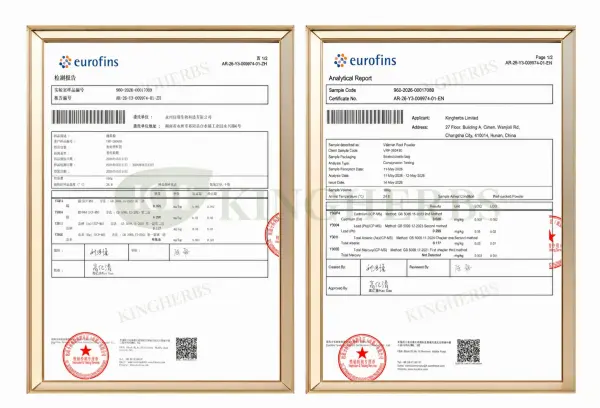
Before receiving a product, verify the batch/lot number, date of manufacture, and date of expiry/best before date for watermelon fruit powder. Ensuring the country of origin and the raw material traceability to the source location is vital. The CoA submitted must be for the batch supplied and not a generic template. Inquiry concerning the retention sample policy, supplier complaint, and recall process. These replies will give us an understanding of how the firm is operated before and after the transaction.
Supplier Document and Compliance Checklist
Good vendors will give you some kind of documentation without you having to ask them again. If you observe a partial or reluctant answer in vetting, that’s a red flag.
| Document or Evidence | Why It Matters |
|---|---|
| Product specification | Defines measurable acceptance criteria for every shipment |
| Batch CoA | Confirms actual lot performance against the written spec |
| HACCP plan or summary | Demonstrates documented food-safety control points |
| ISO 22000 or FSSC 22000 certification | Supports independent food-safety management verification |
| GMP evidence | Supports controlled, repeatable manufacturing conditions |
| Allergen statement | Supports accurate label and risk management decisions |
| Organic certificate | Required for any certified-organic market claim |
| Pesticide and heavy-metal reports | Supports contaminant control across each sourcing region |
CE, UL, RoHS, REACH, and ASTM marks generally do not apply to a food powder directly; they typically cover equipment, packaging materials, chemicals, or electrical products instead, so do not expect to see them on a raw material CoA.
Where to Source High-Quality Watermelon Powder for Commercial Production?
Supplier Capability and Evaluation
Do your investigation before you buy into the campaign. Manufacturing location verified. Food-safety certification. Sourcing of raw materials declared. 2. Batch testing and traceability. Experience in exports. Reliable delivery times. Technical help for OEM, private label projects, and custom packaging.
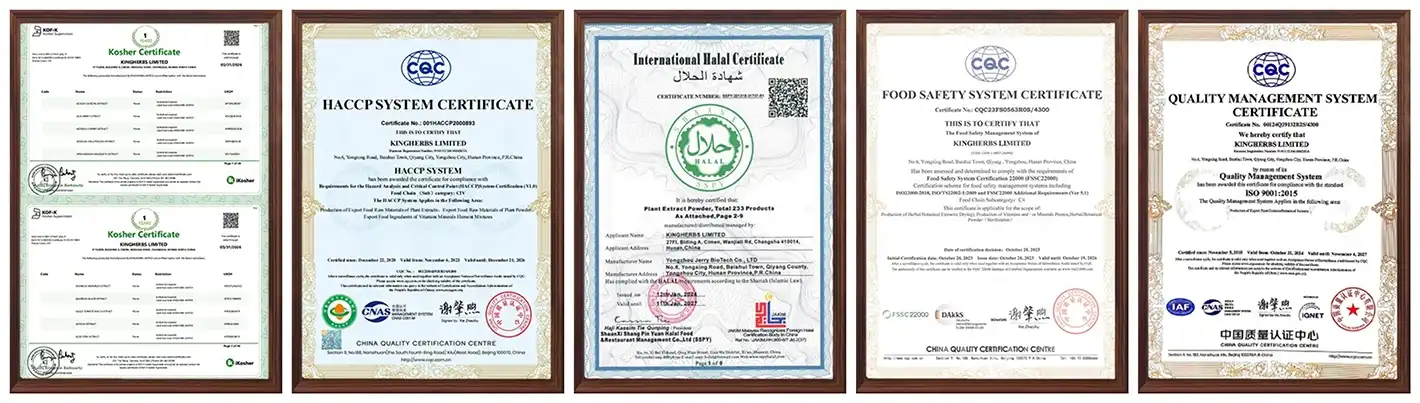
Kingherbs Limited has been a manufacturer and exporter of botanical and herbal items since 1996. They are developing Watermelon powder from the fruit of Citrullus lanatus. It is available as a pale pink to light yellow powder in 25-kilogram barrels. It is certified ISO 9001, FSSC 22000, Kosher, Halal, HACCP, FDA, and EU/USDA Organic. Small trial orders in kg and samples may be supplied before the normal commercial MOQ of 25kg. We have products in store, ready for speedy delivery by courier, air, or sea freight.
In an internal Kingherbs 2024 study of 42 beverage and supplement customers, 68 percent of former formulation rejections were due to a CoA that did not match the batch given or inconsistent moisture content. This is why every Kingherbs delivery includes an HPLC analytical report unique to that batch, allowing customers to confirm the active chemical levels before a manufacturing run, and not find a discrepancy after production.
Commercial Procurement Factors
Please check minimum order quantities & trial order rules, price per kilogram & volume price breaks for watermelon fruit powder, availability of samples, and standard & bespoke packing. Production lead time, reorder lead time, payment conditions, and Incoterms such as EXW, FOB, CIF, or DDP will affect the landing cost and delivery date. Check the port of loading, documents required for the destination, shelf life under defined storage circumstances, and the process for nonconformance and replacement of the provider. Before signing the first purchase order
Supplier Comparison Table
| Evaluation Area | Supplier A | Supplier B | Required Evidence |
|---|---|---|---|
| Drying technology | Process description | ||
| Product type | Specification and ingredient statement | ||
| MOQ | Written quotation | ||
| Lead time | Production schedule | ||
| Certifications | Current certificates | ||
| Testing | Batch CoA and lab reports | ||
| Packaging | Material, size, and barrier data | ||
| Incoterms | Commercial terms | ||
| Private label/OEM | Packaging and formulation scope | ||
| Traceability | Lot-control documentation |
EU and US Import and Compliance Notes
If you are selling in the EU, see the General Food Law (Regulation (EC) No 178/2002) (European Commission, 2002), food hygiene (Regulation (EC) No 852/2004) and limits for pollutants and pesticides. If you are bringing an organic claim, see the organic law (Regulation (EU) 2018/848). You will also need to consider FDA food and dietary supplement standards, CGMP regulations under 21 CFR Part 117 or Part 111 depending on product classification (FDA, 2024), facility registration where applicable, and labeling and allergy limitations for sales in the US. • Review importer of record, customs classification, commercial invoice, packing list, and certificate of origin for first shipment clearing customs.
Starting a Trial Order Without the Usual Guesswork
Many customers have been burnt by an uneven color or CoAs not matching reality on a former transaction and are gun reluctant to change providers. And that is a fair enough hesitancy, which is why a tiny trial purchase, tested to your own specified standard, is more crucial than a sales presentation. Order a trial batch and carry out your own sensory and stability testing and compare the findings with the checklists in this advice before making a commercial order of 25kg or more.

Conclusion
Watermelon powder may provide natural taste and color, as well as easy formulation for smoothie and supplement products, while also providing year-round supply reliability. Whole fruit powder for broad fruit placement, juice powder for drinking purposes, freeze-dried material for improved sensory properties, and spray-dried material for scalable, price-sensitive manufacturing. Choose one or the other, but be sure to ask for Batch testing and regulatory paperwork before you give the green light for commercial clearance, since it is the paperwork that will keep your brand when the product hits the store.
FAQ
1. What is watermelon powder?
Watermelon powder is dehydrated watermelon fruit or juice milled into a shelf-stable powder. Its composition depends on the fruit fraction used, the drying method, any carriers added, and the processing conditions applied during manufacturing.
2. How is watermelon powder made?
Manufacturers wash and process watermelon before drying it through freeze-drying or spray drying. The dried material is then milled, screened, tested, and packaged under moisture-controlled conditions to protect shelf life.
3. What are the benefits of watermelon powder in smoothies?
It can provide watermelon flavor, pink-to-red color, portion consistency, and easier storage than fresh fruit. Nutritional value depends on the product's tested nutrient profile and the serving size used in the final formula.
4. Is watermelon powder the same as watermelon juice powder?
No. Whole-fruit powder may contain more fruit solids and fiber, while juice powder comes from pressed watermelon juice and often has a different flavor, solubility, and nutrient profile.
5. Which is better: freeze-dried or spray-dried watermelon powder?
Freeze-dried powder often keeps stronger fresh-fruit characteristics but typically costs more per kilogram. Spray-dried powder is generally more economical and fits high-volume beverage manufacturing better.
6. Can watermelon powder support hydration?
Watermelon powder contributes fruit flavor and some minerals, but it may not supply enough sodium for a complete hydration formula on its own. Evaluate the finished product's full nutrition profile against its intended use before marketing it as a hydration solution.
7. How should watermelon powder be stored?
Store it sealed in a cool, dry, dark location away from moisture and heat. Follow the supplier's stated temperature, humidity, packaging, and shelf-life guidance to avoid caking or color fading.
8. How do I choose a high-quality watermelon powder supplier?
Review the written specification, batch CoA, food-safety certifications, contaminant testing, traceability records, MOQ, lead time, packaging options, and export documentation. Request a sample and test it directly inside your intended finished formulation before approving a commercial order.
Ready to Test a Watermelon Powder Sample in Your Formula
Reformulating around a new fruit powder does not need to feel like a gamble. KH, the trading name of Kingherbs Limited, supplies watermelon powder manufactured and tested under ISO 9001, FSSC 22000, and HACCP controls, with batch-specific HPLC reports included on every shipment. Whether you need a trial-kilogram sample or you are comparing us as a watermelon powder manufacturer for a full-scale production order, reach our technical team at info@kingherbs.com to request a specification sheet and current pricing.
References
1. U.S. Food and Drug Administration. "Current Good Manufacturing Practice, Hazard Analysis, and Risk-Based Preventive Controls for Human Food," 21 CFR Part 117, 2024. https://www.ecfr.gov/current/title-21/chapter-I/subchapter-B/part-117
2. U.S. Food and Drug Administration. "Current Good Manufacturing Practice in Manufacturing, Packaging, Labeling, or Holding Operations for Dietary Supplements," 21 CFR Part 111, 2024. https://www.ecfr.gov/current/title-21/chapter-I/subchapter-B/part-111
3. European Commission. "Regulation (EC) No 178/2002 Laying Down the General Principles and Requirements of Food Law," 2002. https://eur-lex.europa.eu/eli/reg/2002/178/oj
4. European Commission. "Regulation (EC) No 1924/2006 on Nutrition and Health Claims Made on Foods," 2006. https://eur-lex.europa.eu/eli/reg/2006/1924/oj
5. U.S. Department of Agriculture. "FoodData Central: Watermelon, Raw," 2023. https://fdc.nal.usda.gov/
6. International Organization for Standardization. "ISO 22000:2018 Food Safety Management Systems — Requirements for Any Organization in the Food Chain," 2018. https://www.iso.org/standard/65464.html
About the Author
Cathy, Manager at Kingherbs Limited, has worked in botanical and herbal ingredient supply since joining the company's technical and quality team, supporting dietary supplement, beverage, and cosmetic manufacturers across export markets. Her work focuses on batch traceability, HPLC verification, and formulation support for clients moving from lab trial to commercial-scale production. Cathy regularly advises procurement and R&D teams on specification writing and supplier documentation for fruit and botanical powders.
Send Inquiry
Related Industry Knowledge
- Where to Buy Lespedeza Capitata Extract in Bulk
- Is Apple Root Extract Safe for Sensitive Skin?
- Ivy Extract Powder vs Ivy Leaf Extract: What Is the Difference?
- Best Blueberry Extract Powder 2026: Pure, Science-Backed Guide
- Bamboo Leaf Extract Benefits: Everything You Need to Know
- Does Astaxanthin Powder And Oil Help Protect Heart Health?
- Can Macleaya Cordata Extract Improve Feed Efficiency?
- Can Olive Extract Powder Help Manage Blood Pressure Naturally?
- Purple Sweet Potato Extract for High-Value Antioxidant Formulas
- Lespedeza Capitata Extract for Natural Diuretic Applications